
A surprise map of a book
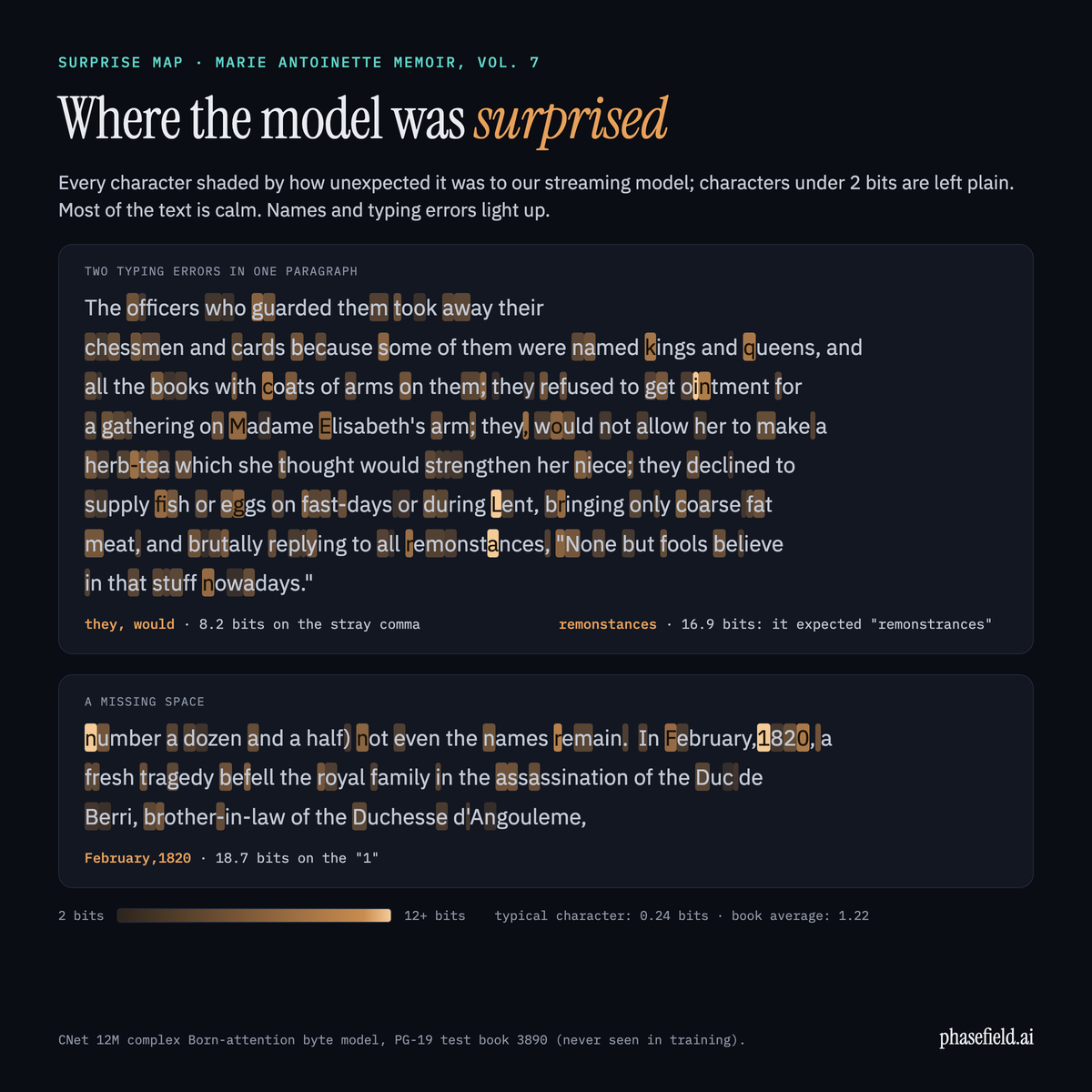
A language model assigns a probability to every next byte. Its surprise at a byte, measured in bits, is the negative log of that probability: near zero when the text is predictable, high when something unusual appears. Plot it along a whole book and you get a map of where the text departs from what the model has learned.
We read Memoirs of the Court of Marie Antoinette, Volume 7 from the PG-19 test set, 164,000 bytes the model never saw in training, with CNet's 12-million-parameter complex-valued model. Born attention lets the model read text as a stream with a fixed-size state, so a book of any length costs it the same memory. The average was 1.22 bits per byte; a typical character cost 0.24 bits.
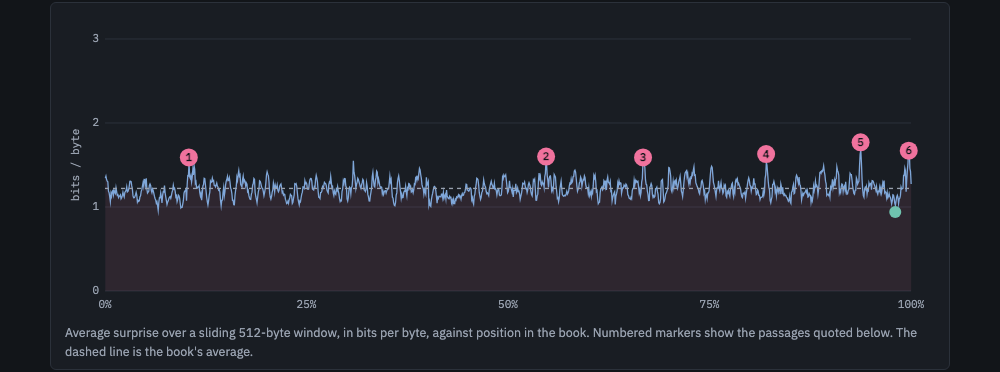
What stands out
- Dense runs of names. Five of the six peaks are lists of people: the royal family's attendants, the revolutionaries Hébert and Chaumette, a panel of physicians, the false claimants to the throne. Names are hard to predict byte by byte.
- A change of structure. The sixth peak is the transcriber's index of quotations at the end of the file: sentence fragments in alphabetical order, not prose.
- Typing errors in the source. These are the sharpest signals of all.
| In the source text | What the model expected | Surprise |
|---|---|---|
| February,1820 | a space after the comma | 18.7 bits on “1” |
| remonstances | remonstrances | 16.9 bits on “a” |
| they, would | no comma | 8.2 bits on “,” |
| Laasus (Lassus a line later) | Lassus | 8.0 bits on the second “a” |
The most predictable stretch was plain narrative prose: the allied monarchs arriving in Paris, most characters well under one bit.
How it reads a whole book
A standard Transformer keeps a key and a value for every byte it has read, so its memory grows with the text. A model of the same size that kept this whole book in its attention cache would need about 2.7 GB by the last page. Born attention instead folds each byte into one fixed-size state: 12.8 MB on the first page, on the last page, and after five million bytes.
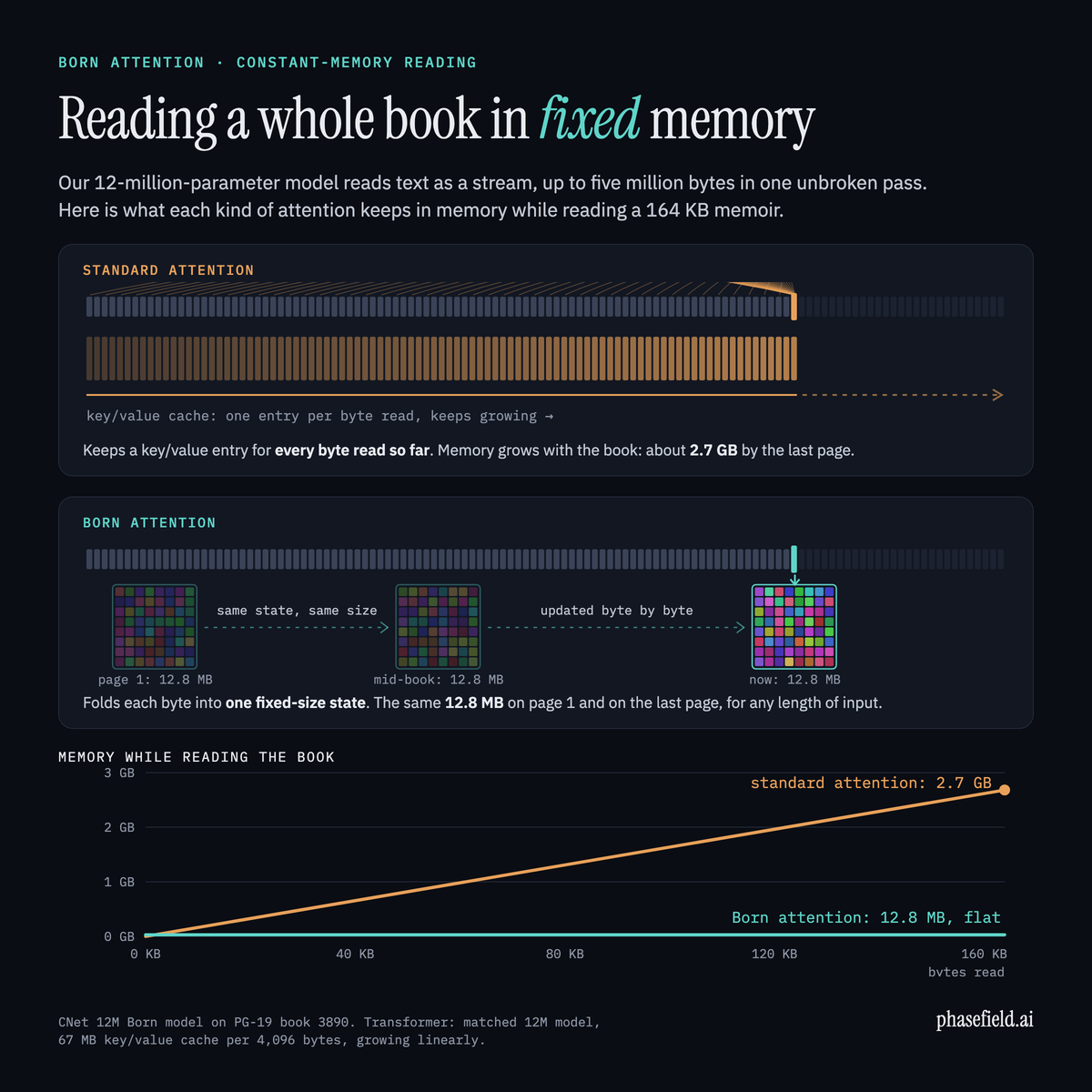
Fixed memory is not the same as remembering everything. Today the model draws mostly on the last few thousand bytes, as we measured in Streaming is not memory; extending that is our next experiment.
Why this matters
A model that streams in fixed memory can make this pass over any amount of text, or any signal, cheaply: flagging transcription errors, unusual passages, or boilerplate in a corpus; ranking documents for training data; compressing. The same idea carries to radio, our first application, where streaming surprise over raw IQ samples is anomaly detection on the spectrum.
Method: CNet's CPU streaming decoder. To score on CPU quickly, the book was split into ten pieces scored in parallel, each warmed up on the 4 KB before it. The model draws mostly on the last few thousand bytes, so this closely matches a single unbroken pass. The code is in CNet (generate -eval ... -eval_dump).