
Is that aircraft really who it says it is? Live verification of ADS-B transmitters
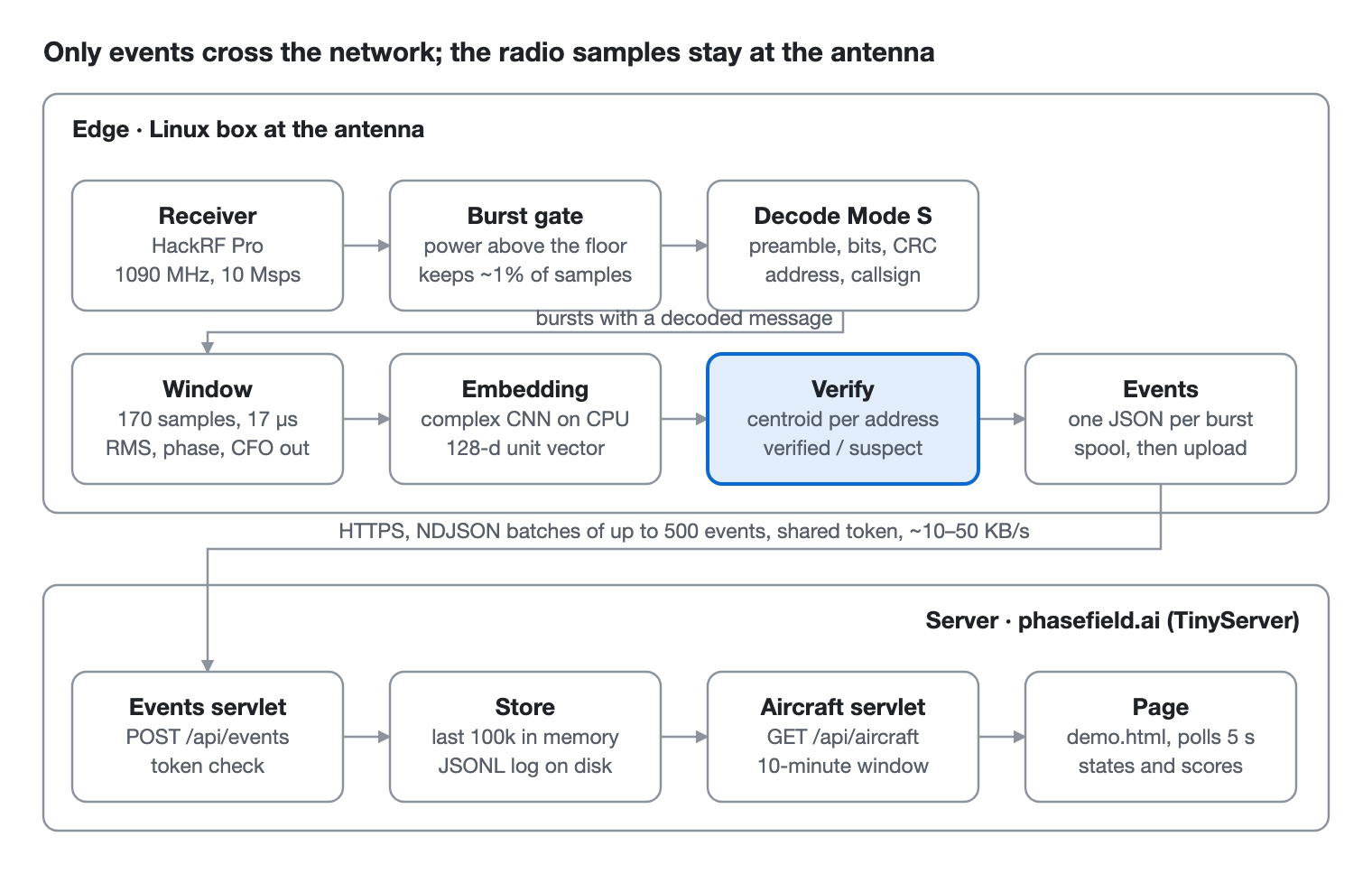
Every Mode S burst that claims an aircraft address is checked against that address's own transmitter signature, enrolled from its first bursts in this pass. How it works · Full write-up (PDF)
takes the next ten real bursts of the aircraft heard most recently and relabels them, at the edge, with the address of another aircraft drawn at random (twins with a near-identical signature excluded); the detector has to catch it
–aircraft in window
–bursts verified
–bursts suspect
–enrolling
–address-less bursts attributed
–edge memory
| address? | callsign? | alt ft? | state? | verified? | suspect? | enrolling? | last score? | last 10-burst score? | mean 10-burst score? | last seen? |
|---|
Latest suspect bursts
| time? | claimed address? | score? | nearest other? | its score? | DF? | note? |
|---|
Scores are cosine similarities of a learned 128-dimensional transmitter embedding (CNet / Phasefield). A burst is "suspect" when it claims an address whose enrolled signature it does not match; a lone miss on a weak burst is normal and leaves the aircraft green, four among its last ten turn it amber (degraded) for a minute; an alert (red, held for two minutes) needs the mean of its last ten bursts to match another aircraft's signature better than its own by a margin, with at least three of them flagged, on three consecutive bursts; a weak signal that merely fails its own signature stays amber. Write-ups: how the system works · the measurements behind it (paper) · all Phasefield papers.